|
Do You Love
Yourself?
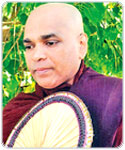 Dr. Most Venerable Dr. Most Venerable
Mirisse Dhammika Nayaka Thera
King Kosala, a contemporary of the Buddha, asked his wife Queen Mallika “my
dearest Mallika, whom do you love the most in the world”? She said “My Great
King, I love myself the most”.
King Kosala was hurt and brought this colloquy to the Buddha for analysis. The
Buddha stated that Queen Mallika’s answer was correct and true to all worldly
beings. Probably, every one of us has asked this question from someone in our
lives; it may be man from the wife and vice versa or children from parents or
those who have fallen in love with each other. The answers may differ from that
of Mallika’s.
Why does an infant cry? There is a multitude of reasons such as hunger and
thirst etc. When hunger is eliminated, crying stops. What does this mean? Even
though an infant doesn’t know the parents well, it loves them because they
provide food and tender care. All this makes the infant happy. If parents leave
the child in the hands of a caregiver, the child will love profoundly the
caregiver who provides the necessities such as love, tenderness, care and food.
If one offers love and care to others, one will receive them too.
A noble bondage that connects parents with children is love. It is a condition
caused by ego-centered attachment. When offspring are successful in their
education or in a career, the parents become extremely happy because it is their
accomplishment. This becomes evident in a family with a number of children.
Often, the child who excels in every aspect experiences profound parental love
because of the accomplishment of parental expectation. It reveals that this
noble love is egocentric.
According to the Buddha’s Teachings rebirth is caused due to egocentric
attachment. It is firmly anchored in the subconscious mind. Loosening this grip
of attachment and its final eradication are known as nibbana. Anyone who loves
oneself has to be sorrow less not only in this birth but also in the infinite
path of samsara (infinite deaths and rebirths). The state of sorrowlessness can
be achieved by following the peaceful path taught by all Buddhas.
Be free from all unwholesome things; Amas all wholesome things; Liberate the
mind of all defilements. |